How Often Should an AEC Firm Send Client Surveys?

.png)
- Many AEC firms reassess survey cadence as end-of-project feedback misses issues that surface mid-delivery.
- That gap becomes costly because 31% of firms report project problems that could have been prevented with milestone-based check-ins.
- This is why experts recommend pairing annual surveys with light, friction-free milestone pulses to capture real-time client sentiment.
- ClearlyRated strengthens this approach by delivering higher response rates and clearer insights, making each feedback cycle more actionable.
You made a smart investment by launching a new feedback platform, and now your first client surveys are live and circulating. Some project teams are even excited. But as time passes, the energy fades when participation drops and reminders stop going out.
If you’re asking how often you should send client surveys to AEC firms, you’re not alone. According to recent research, 31% of AEC firms only survey at the end of a project, while another 21% send feedback at key milestones. In other words, many firms struggle to build continuous feedback routines and miss out on real-time insight.
Experts in AEC client survey best practices recommend pairing an annual baseline survey with project-milestone surveys at kickoff, midpoint, and near completion. In this article, we’ll dig into exactly how often you should send client surveys, depending on your project types, along with smart tips for capturing more meaningful, actionable feedback.
Why Survey Frequency Matters in AEC Projects
Client feedback is a critical driver of success in architecture, engineering, and construction (AEC) projects. With projects often spanning months or even years, getting input at the right moments can help firms avoid misalignment, catch issues early, and improve client satisfaction.
Survey fatigue vs. insufficient feedback: Finding the balance
As an AEC firm, getting feedback only at the end hardly tells you what went wrong in the middle. At the same time, you can’t fire off surveys too often. If you survey every week, clients may start tuning out because they feel overburdened. That’s survey fatigue.
But if you wait too long, you’ll get insufficient feedback, which can lead to gaps in understanding client needs and risks, and long-term relationship damage.
Let’s say a mid-size engineering firm sent weekly surveys to a client during a 12-month project. Response rates dropped from 85% to 25% by the sixth survey. Conversely, a competitor who only surveyed post-project missed critical communication gaps, resulting in delayed project approvals and dissatisfaction.
To find the right balance for how often to send client surveys as AEC firms, consider the following points:
- Conduct a baseline annual survey to get a broad sense of client satisfaction
- Send extra surveys at meaningful project milestones, such as design approvals, mid-project reviews, and just before final delivery
- Limit the frequency to avoid overwhelming clients, aiming for timely feedback that informs action without causing fatigue
The optimal survey balance captures valuable insights while respecting client time, usually tied to milestones rather than arbitrary intervals.
The Unique Challenge of AEC Client Feedback Timing
AEC projects are inherently multi-layered, involving design iterations, approvals, technical reviews, and field execution. This complexity creates unique feedback challenges.
Multiple stakeholders and decision-makers
Owners, project managers, contractors, and end-users all have distinct perspectives. If you send just one survey at the project's end, you are likely to miss these viewpoints.
Segmenting feedback by stakeholder group and project phase ensures actionable insights. Here’s a practical way to do that:
- Map stakeholders to survey touchpoints. For instance, ask the construction manager about communication quality during the construction administration phase.
- Ask the project owner about design satisfaction after design deliverables are finalized.
- Survey end users or facility managers only after the building is occupied, so you understand how the design works in reality.
Distinct project phases require different feedback
AEC projects follow sequential phases, with each phase generating different kinds of experience and feedback:
- Design phase: Check if your clients felt the design ideas were clear and if your team was responsive to their early input
- Documentation phase: See how clients rate the technical quality, coordination, and clarity of construction documents
- Construction phase: Measure communication, problem-solving, and progress updates
- Post-occupancy phase: After handover, survey people using or maintaining the building to understand actual user satisfaction, operational challenges, and lessons for future projects
In fact, client experience is a real battle in AEC today. In a recent study, 47% of clients in the AEC industry reported that inconsistent communication damages their trust in the firm. This highlights that if you don’t time your surveys well and don’t consider all stakeholder groups, you miss capturing complete feedback.
By aligning surveys with phases, firms can capture specific insights that drive continuous improvement.
Recommended Survey Frequency for AEC Firms
A strategic AEC project feedback cadence not only strengthens client relationships but also drives continuous improvement and long-term loyalty.
Post‑project surveys: The non‑negotiable baseline
Every project should conclude with a post‑project survey, as this is the most reliable way to capture clients’ genuine reflections. Such feedback helps you understand overall satisfaction, celebrate best practices, and uncover opportunities for improvement. In fact, 51% of clients rate post‑project follow-up as a critical component of their overall customer experience, highlighting the importance of asking the right questions.
Some of the key areas to probe include:
- Quality of deliverables: Was the final output up to the client’s expectations?
- Adherence to budget: Did the project stay within financial parameters?
- Project schedule: Was the project completed on time?
- Team communication: How effectively did your team communicate with the client?
- Problem resolution: Were challenges addressed smoothly and promptly?
The ideal time to send this survey is within one to two weeks of project completion, while clients’ memories are still fresh and their experiences are vivid.
Mid‑project milestone surveys: Catching issues early
Inserting short, focused surveys allows firms to address challenges before they escalate.
For example:
- At design approval points, ask whether the direction still aligns with client expectations.
- During construction phases, especially at major production or coordination junctures, check in on schedule, quality, and how well your contractors are working together.
But here’s the issue. While 80% of firm leaders believe they're delivering a standout client experience, only 8% of clients actually agree. That stark disconnect, as highlighted in our 2025 Benchmarks, Insights, and Trends: Client Experience in the AEC Industry report, is a massive blind spot.
This kind of phased feedback is particularly valuable in AEC, where projects are long and involve many stakeholders (owners, contractors, project managers). To maximize participation, three–five carefully selected questions are often enough to surface core issues without fatiguing clients.
As CMSWire warns, long, repetitive, or complex surveys increase the likelihood of abandonment.
Quarterly relationship health checks for ongoing clients
For clients on retainer or repeat engagements, quarterly “relationship health” surveys are highly effective. Many AEC firms say customer experience directly impacts repeat business. In fact, 65% of firms in a report believe CX affects client retention.
These quarterly surveys don’t have to be long. Plus, they should focus less on discrete project deliverables and more on the quality of the working relationship. For example:
- How well your team is communicating
- How responsive are you
- The level of trust
- The alignment of strategy and objectives
These regular check-ins help you catch friction early, adapt your approach proactively, and ultimately boost client retention and high-quality referrals. They also ensure there are no surprises when it's time for contract renewal or renegotiation.
Annual NPS benchmark surveys
At least once a year, you should run a formal Net Promoter Score (NPS) survey. Its purpose isn’t just to get a number, but to track client sentiment over time, benchmark loyalty, and measure referral potential. NPS is most valuable as a longitudinal metric, as it gives you a clear picture of how your client relationships evolve year over year, rather than reflecting a temporary pulse.
From a strategic perspective, many AEC firms are now hiring dedicated CX strategists and implementing a formal AEC feedback program to include client experience as a business discipline, not just a marketing or relationship function. This thinking holds that understanding client loyalty through NPS helps inform annual planning, client retention strategies, and long-term growth.
📌 Interesting read: How to Capture Post-Construction Feedback That Actually Gets Replies
Survey Timing by Project Phase
Now, let’s break down when to survey during different project phases, so you capture real insight at the right moments:
Design development phase: Concept approval feedback
In this stage, you should gather feedback on whether clients feel the design concepts are clear and whether your team has responded well to their input.
Use short, mostly multiple‑choice questions, and leave a few open fields for comments. That gives you both structured data and room for honest, actionable feedback.
Construction documentation phase: Technical review checkpoint
Here, focus your survey on things like accuracy, coordination, and the level of technical detail. Mistakes or misunderstandings at this point can lead to costly rework.
According to a recent report, 34% of client complaints come from poor documentation, making this an especially valuable moment to check in.
Construction administration phase: Progress and communication assessment
During construction, ask clients to evaluate how well you communicate changes, resolve problems, and maintain quality controls. This phase matters because communication breakdowns here are frequent.
In fact, 68% of AEC clients say they expect real-time updates during construction.
Post-occupancy phase: Final deliverable satisfaction
Once the project is handed over, send a survey on long-term satisfaction, the building's usability, and its performance in day-to-day operations. This feedback helps you understand how your design works in real life and gives you great case-study material.
Post-occupancy surveys also help inform your architecture firm's client survey frequency, as they show clients you care about their experience even after delivery.
Survey Frequency Based on Project Type and Duration
Every AEC firm’s feedback rhythm should match the length and complexity of your projects:
Short-term projects (under six months): 1-2 survey touchpoints
These fast-paced jobs require only one–two survey touchpoints, typically one in the middle and one after completion. Because the project moves quickly, you don’t need many surveys to gather valuable feedback.
Short, well-timed surveys help you capture genuine reactions without overwhelming clients.
Medium-term projects (Six-18 months): 3-4 survey touchpoints
For projects that stretch over several phases, aim for three-four surveys:
- At design approval
- When construction begins
- At mid-construction
- A final post-project check
You’ll catch early warning signs in time, and that helps you correct course before small issues become bigger problems. According to Gitnux’s 2025 AEC industry data, 47% of clients say inconsistent communication damages their trust, so staying in touch more frequently really pays off.
Long-term projects (18+ months): Quarterly pulse surveys
When you run a multi-year engagement, quarterly pulse surveys make sense. These shorter surveys let you maintain contact, keep stakeholders aligned, and sense problems as they emerge.
AEC firms now rely on digital feedback tools and real-time communication, as 78% of clients expect ongoing transparency and updates.
Ongoing retainer relationships: Biannual or quarterly surveys
If you work with clients continuously, say, on retainer or for recurring design work, use biannual or quarterly surveys, depending on the level of engagement.
That approach helps preserve long-term relationship health without overwhelming your clients with constant questioning.
Factors That Should Influence Your Survey Cadence
Deciding how often to survey isn’t random. It depends strongly on who your clients are and how complex your projects are.
Client relationship value and strategic importance
If you’re working with a high-value or strategic client, you should survey them more often. These clients usually set the tone for how you deliver service across your firm, and their feedback can influence your internal benchmarks. In fact, trust, long-term performance, and innovation matter deeply to such clients, not just cost or schedule.
According to our Client Savvy platform, surveying critical clients frequently helps you build loyalty, capture their changing expectations, and spot opportunities before they walk away.
Project complexity and number of stakeholders
Projects that involve many subcontractors, consultants, or technical specialties demand a more thoughtful survey cadence. If there are multiple stakeholders, you need phased surveys, so you hear from each group when their priorities matter most.
Simpler projects, on the other hand, need fewer surveys, but you should never skip a post‑project review.
How ClearlyRated Solves Survey Timing for AEC Firms
Standard survey tools cannot capture the complexity of professional services. When paired with a robust customer relationship management (CRM) platform, the power of feedback multiplies. Feedback tells you what is happening, while a CRM platform tells you who it is happening to, when, and where in the relationship lifecycle.
The Client Savvy platform is explicitly built for AEC and professional services firms. It integrates directly with project workflows, closes feedback loops, and empowers leaders to act on insights that drive satisfaction, loyalty, and referrals.
Pre-designed survey schedules based on AEC industry data
To consistently capture meaningful feedback, we offer pre-configured survey schedules informed by thousands of AEC projects and industry research. These schedules are optimized for project type, size, and complexity, ensuring that feedback is collected when it is most accurate and actionable.
According to our survey data, 78% of AEC buyers say a seamless experience influences their decision to pick a firm, and 68% value strong communication as much as technical skill. These embedded schedules let you trigger surveys at project milestones, so your feedback process reflects how your work actually unfolds.
Automated survey distribution at project milestones
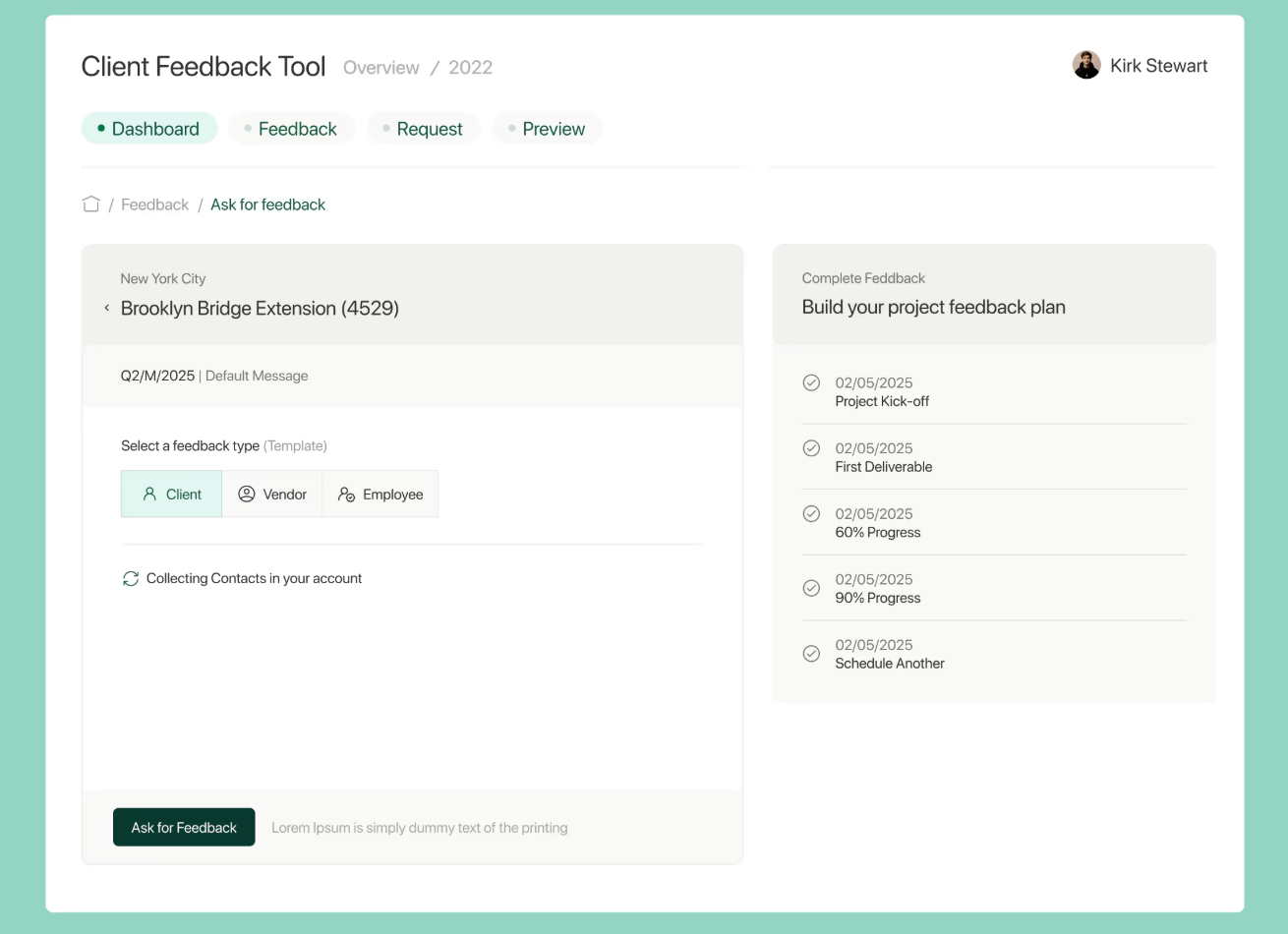
Manual survey distribution is time-consuming and prone to delays. We automate delivery at critical project milestones, so that feedback is gathered consistently and actionably.
For instance, the platform automatically sends feedback surveys when the design is approved, when construction starts, and at handover. This setup ensures that you collect timely input exactly when your clients’ feelings are most relevant.
Milestone-triggered feedback helps you catch issues early and act while they still matter.
Built-in frequency controls to prevent survey fatigue
Our platform builds in rules to control how often you survey each client, so you avoid annoying them with too many requests. These controls help maintain engagement without burning out your respondents.
As firms shift from occasional surveys to ongoing Voice of the Client (VoC) programs, this kind of automation has become a trend for 2025.
Industry benchmarks showing optimal response rates by timing
Understanding how your survey timing compares with that of other AEC firms can give you a serious competitive edge. Independent benchmarking surveys provide an unbiased view of your firm’s performance, highlighting strengths that might impress clients and exposing blind spots that self-reported data can miss.
The Client Savvy platform takes this a step further with real-time dashboards that show feedback at the individual, project, and client levels.
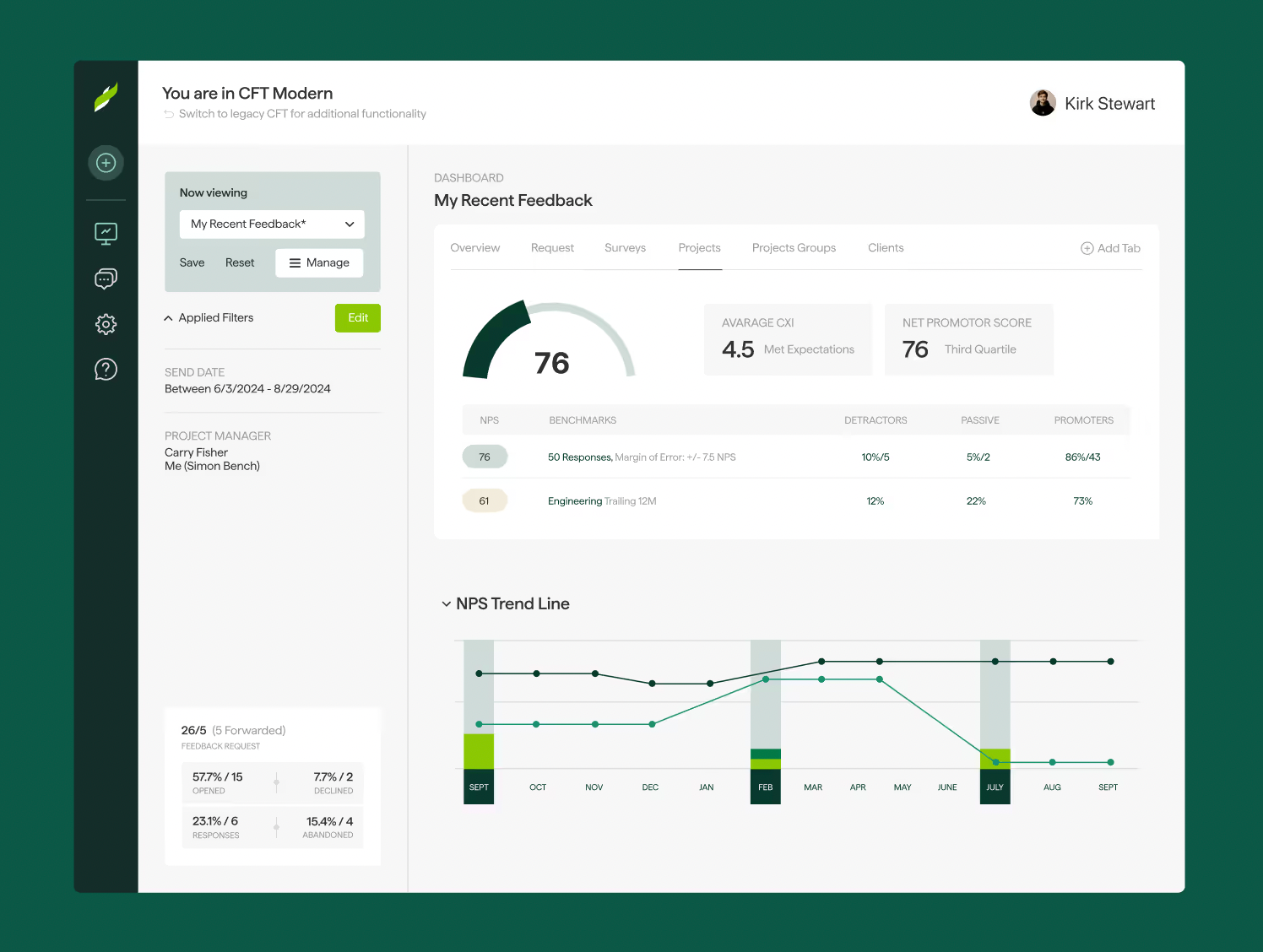
Additionally, you get clear insights into how your response rates, survey timing, and overall client experience compare with those of hundreds of other firms in the industry. This lets leaders spot patterns, uncover potential issues early, and take action before minor problems grow into larger ones.
Some of the key results reported by firms using the platform include:
- Four times more pain points discovered compared to traditional NPS surveys, uncovering issues before they escalate
- Eighty-three percent of at-risk clients retained by addressing hidden frustrations with closed-loop accountability
- Seventeen-point increase in NPS after implementing ongoing milestone-based feedback
- $1.8 million in referrals gained by activating promoters identified through the platform
Measuring the Impact of Your Survey Frequency
Sending surveys at the right time is just the first step. Tracking their effectiveness is what turns feedback into actionable insight. Without monitoring how clients respond and how their satisfaction evolves, even the most well-timed surveys can fall short of improving your projects and relationships.
To truly measure the impact of your survey cadence:
- Track response rates by project phase, project type, and client segment to identify where your surveys are most effective and where adjustments are needed.
- Monitor trends in satisfaction scores and NPS over time to see how client sentiment shifts across projects, phases, and long-term relationships.
- Adjust cadence based on results: increase survey touchpoints for strategic clients or highly complex projects, and scale back for short-term engagements where frequent surveys could cause fatigue.
Building a Sustainable Survey Calendar for Your AEC Firm
Creating a well-structured survey calendar keeps your client feedback program consistent, actionable, and aligned with project milestones.
To make this practical for your firm, you should focus on two key steps that form the foundation of an effective survey program:
Mapping survey touchpoints to your standard project lifecycle
Align surveys to your firm’s project phases, such as design development, construction documentation, construction administration, and post-occupancy. This makes the client’s feedback relevant and timely.
Randomly scheduled surveys often miss key moments when client input can prevent issues or improve outcomes. Once you map the touchpoints, you can pinpoint which moments will provide the most valuable client insights.
After identifying the right timing, create templates for each phase to streamline feedback for both clients and your team.
Creating survey templates for each project phase
Designing survey templates for each project phase streamlines feedback collection. Standardized templates maintain consistency while allowing customization for specific milestones. Templates also reduce client effort and help your team analyze results efficiently.
Once you have templates, your firm can focus on reviewing responses and implementing improvements instead of creating surveys from scratch for every project.
Consistency Beats Frequency
Failing to follow a structured survey schedule can lead to missed feedback, client frustration, and lost opportunities to improve projects. Many AEC firms either overwhelm clients with too many surveys or gather feedback too late to take meaningful action.
Our platform helps firms avoid these challenges by providing data-driven, milestone-based surveys that deliver feedback at the right time.
Consistently surveying clients at key project milestones allows your firm to:
- Capture high-quality insights while respecting client time
- Detect issues early before they escalate
- Strengthen client relationships through proactive engagement
- Turn feedback into actionable improvements for future projects
With ClearlyRated, your firm can automate survey distribution, track responses in real time, and use industry benchmarks to optimize survey timing. Get started today to see how we can help your firm grow!
FAQs
Should AEC firms send surveys during active construction projects or wait until completion?
Both. Milestone surveys during active projects help detect issues early and give teams a chance to correct course. Post-project surveys capture overall satisfaction and lessons learned. Using ClearlyRated, your firm can automatically trigger surveys at the right project milestones without overloading clients.
How many client surveys are too many for long-term AEC projects?
Quarterly surveys are generally sufficient for long-term projects. Sending surveys more frequently can reduce response quality and increase survey fatigue.
What's a good NPS response rate for architecture and engineering firms?
A response rate of above 40% is typical. Even higher rates indicate highly engaged clients, and that surveys align well with project touchpoints.
How do I know if mid-project surveys are effective?
Monitor open-ended feedback, survey completion rates, and the speed of issue resolution. Use these metrics to adjust survey cadence and question design for maximum impact. ClearlyRated tracks responses in real time, making it easier to see which surveys drive actionable insights.
Can survey timing improve project profitability?
Yes. Timely surveys help catch issues before they escalate, reducing rework, delays, and disputes. This improves project efficiency and protects margins.

FAQs








.webp)





.png)

%20(1).png)
.webp)





%5B1%5D.webp)




.png)







_%20The%20Ultimate%20Guide.png)

.png)




%20in%20the%20Workplace.png)




.png)

%20and%20how%20can%20you%20increase%20it.png)
_%20A%20Step-by-Step%20Guide.png)

.png)
.png)

